A practical guide to auditable alert delivery attempts and manual retry in TEMIRIN using configured records, explicit market identity, current controls, and human review.
August 3, 2026 · 5 min read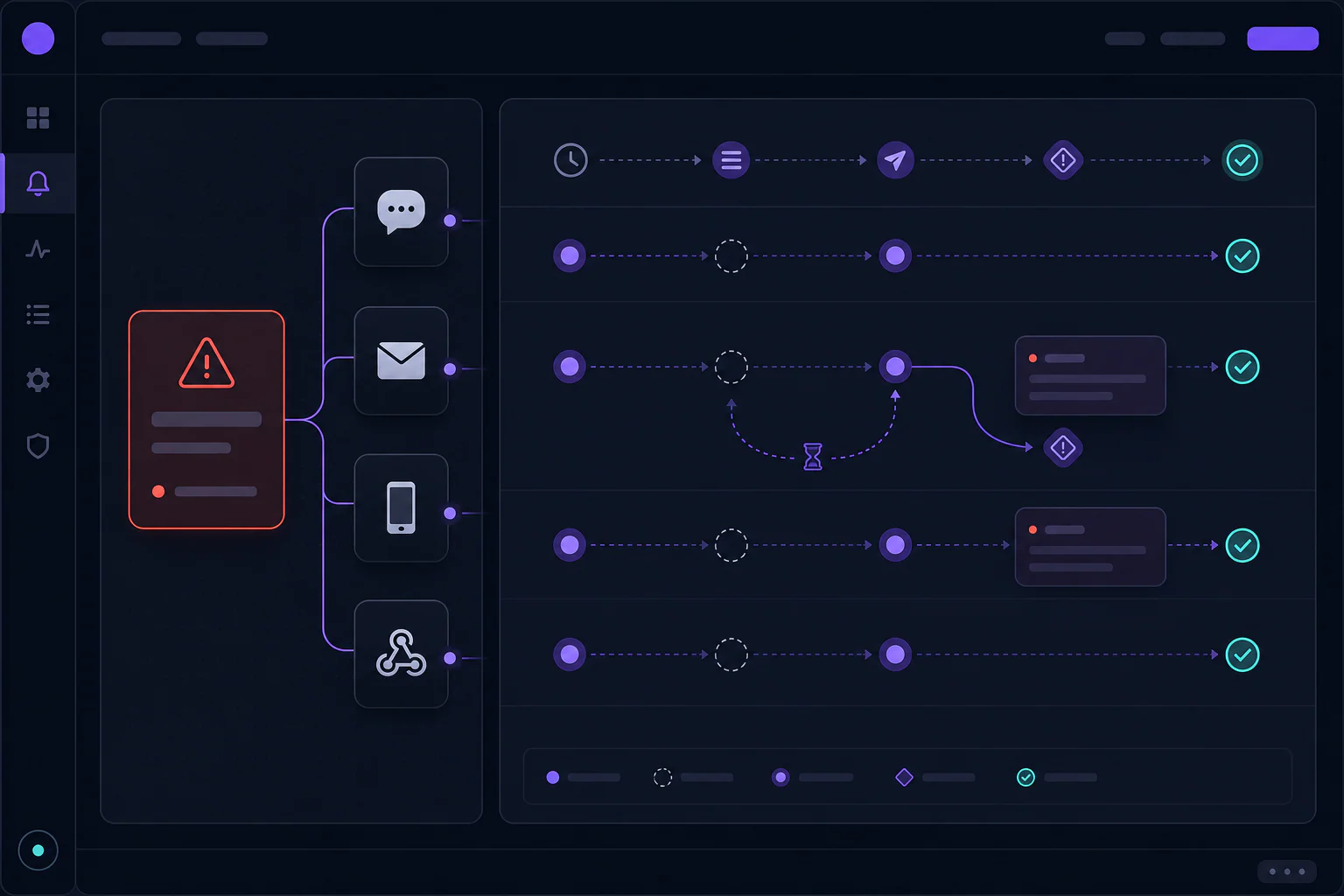
An auditable notification begins with two identities. The alert event describes why the workspace wanted to notify someone: the watchlist-derived record, relevant market ID, trigger and current price context, rule, and creation time. A delivery attempt describes one transport operation to one configured destination. Keeping them separate lets a single alert retain a coherent history when email succeeds, Telegram is delayed, and a webhook requires another attempt.
This distinction also prevents a common analytical error. A delivered message does not mean a reviewer opened it, agreed with it, or created a paper order. TEMIRIN records outbound transport state and keeps authenticated approve or reject actions in the application. The delivery ledger should therefore answer what the system tried, when it tried, and what the destination reported, without changing the opportunity or decision state.
A useful ledger row includes channel, destination label, event ID, attempt number, queued time, start time, completion time, status, and a safe provider response category. Retain an authenticated link to the workspace record where appropriate, but exclude connector credentials, private notes, raw tokens, and sensitive wallet details. Support should be able to distinguish rejected credentials, rate limits, timeouts, and invalid endpoints without seeing the secret itself.
Store the payload version or a safe content fingerprint so a later investigation can tell whether attempts carried the same message. Preserve the event timestamp and market identity across retries; do not rebuild the alert from whatever the opportunity looks like hours later. Current price can be refreshed inside the workspace when the user opens it, while the original notification remains an honest record of what was sent at that time.
Retries are useful only when operators can see why they occur. Temporary transport failures may justify another attempt, while a permanently invalid destination should remain failed until a person corrects its configuration. TEMIRIN exposes delivery history and manual retry for supported channels. That operation should create another attempt attached to the same alert event, not erase the earlier failure or manufacture a new research signal.
Duplicate delivery is always possible when a provider accepts a request but the acknowledgement is lost. Stable event identity and channel-safe idempotency practices reduce confusion, but public copy should not promise exactly-once transport. The receiver should tolerate a repeated event ID, and the workspace should show each attempt. A retry ceiling and clear last-error state are safer than an invisible loop that floods a channel during an outage.
Email, Telegram, Slack, and outbound webhooks differ in credentials, limits, and responses, yet their ledger semantics should stay comparable. Each path needs an enabled destination, a transport result, safe diagnostics, and a route back to the authenticated record. Telegram and Slack messages direct recipients to that protected record, where approve or reject is stored with actor and timestamp. A configured webhook sends outbound review notices while the workspace remains the source of truth for evidence and decisions.
Destination ownership matters as much as code. Name who can change the address, chat, workspace, or endpoint, and review access when a teammate leaves. Rotate or revoke configured credentials through the supported server-side flow, then send a controlled test. The test should create a delivery event and attempt only. It must not create evidence, approve an opportunity, enter a paper order, or contact a venue.
A weekly review can compare event volume, attempted destinations, success and failure counts, retry age, and recurring provider categories. Segment by channel before drawing conclusions because one provider outage can dominate the total. Include alerts with no configured destination and events intentionally left in-app only. These measures describe notification operations; they do not measure market accuracy, user attention, or investment outcomes.
Rehearse both a recoverable failure and a permanent configuration error. Confirm that the first produces a traceable later attempt, the second stops with an understandable state, and neither changes the in-app decision record. After recovery, inspect timestamps and verify that the original event context survived. An audit-ready ledger is valuable because it makes imperfect transport explainable, not because it claims messages can never be delayed, lost, or duplicated.
Close the review by selecting several event IDs and reconstructing every associated attempt from the ledger alone. The sequence should reveal which destination was used, which safe provider result was recorded, who initiated a manual retry, and whether the channel later recovered. If that story requires private credentials or an unstored support assumption, the operational record is incomplete and should be improved prospectively.
The event records why the workspace created a notification. Each attempt records one outbound transport operation to a configured email, Telegram, Slack, or webhook destination.
No. Delivery status covers transport only. Approve and reject actions are authenticated in-app records, and creating a paper order is a separate user action.
No. A useful ledger retains the failed attempt and appends another attempt to the same event so the full operational history remains reviewable.

