A practical guide to fail-closed source and alert operations in TEMIRIN using configured records, explicit market identity, current controls, and human review.
August 3, 2026 · 4 min read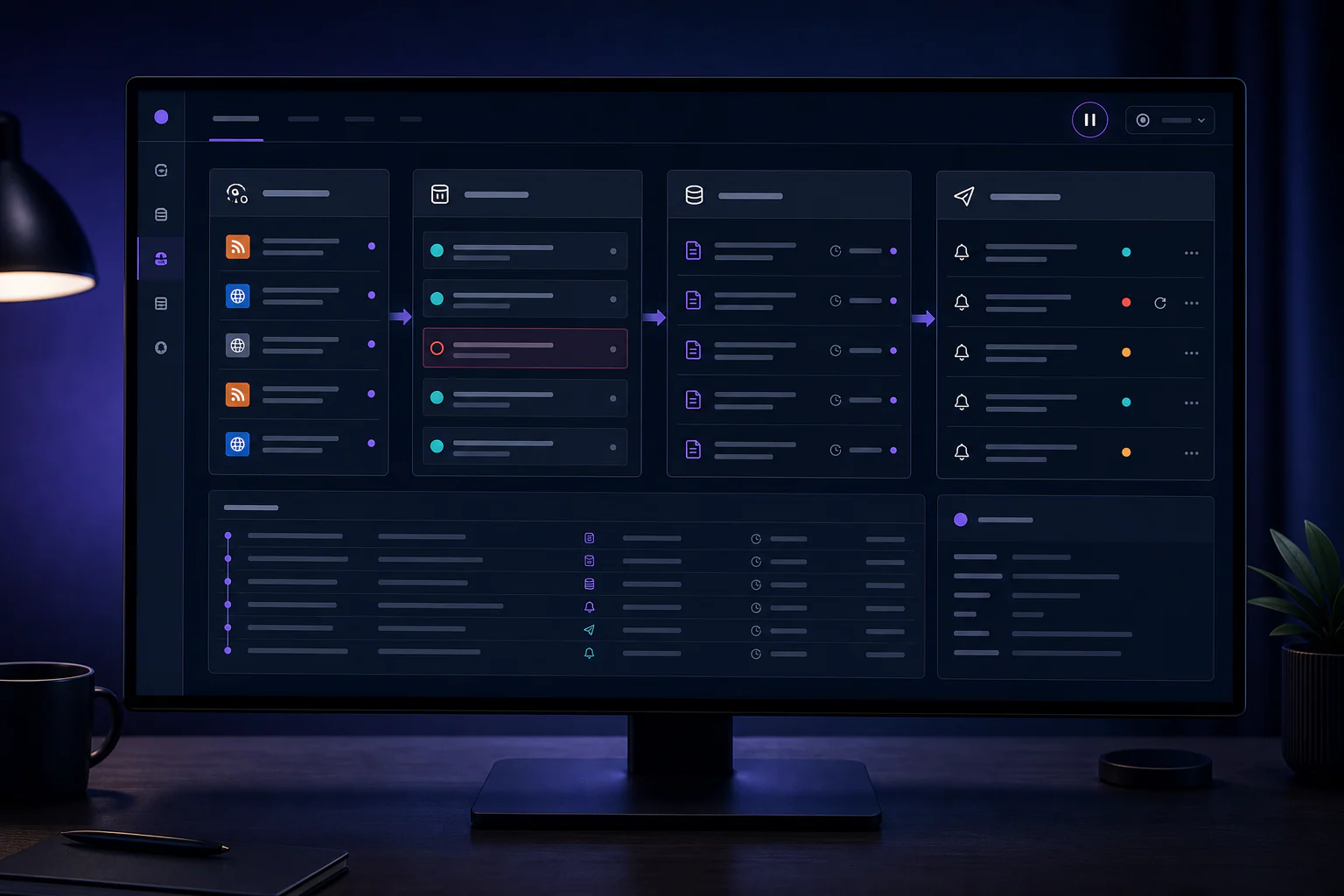
Prediction-market operations contain an inbound evidence lane and an outbound notification lane. RSS and configured web readers collect source records, while email, Telegram, Slack, and webhooks deliver alerts when their destinations are configured. Fail-closed design means uncertainty remains visible and does not silently advance either lane. A failed fetch must not become fresh evidence, and an unknown transport result must not become confirmed delivery.
The lanes also need separate status language. Source ingestion answers whether content was fetched, normalized, deduplicated, and stored with provenance. Alert delivery answers whether an already-created event was attempted at an external destination. A healthy webhook destination cannot compensate for a stale source, and a source record remains valid evidence even if an optional Telegram notice fails. Keeping these state machines distinct makes incidents diagnosable.
Every stored source record should retain its configured source identity, canonical URL or provider reference, observed time, and available publication time. Deduplication should prevent repeated copies from crowding review without destroying the history needed to understand collection. When parsing fails, the source is unauthorized, or the response is stale, retain an operational failure that names the safe reason rather than creating a polished brief from incomplete input.
TEMIRIN uses deterministic briefs over stored fields, and evidence appears beside a market only when the record carries a supported explicit market ID. An item without that identifier remains unlinked evidence in its source context. The watchlist may still produce a market record from its configured data, but a failed or unlinked source must not be presented as support merely because its topic sounds related.
Durable jobs need enough identity to survive a worker restart without silent loss. A recovered fetch should preserve the same source scope and avoid creating another evidence record when the original write succeeded. Operators should be able to see the last successful observation, the failed attempt, and the current retry state. Backoff reduces provider pressure, while a bounded retry policy prevents a broken endpoint from monopolizing the queue.
Recovery must not rewrite history. If a later fetch succeeds, append the new observation and retain the earlier failure for operations review. If duplicate content returns under a tracking URL, canonicalization and content identity should suppress the redundant review item while preserving safe diagnostics. The goal is a traceable record of imperfect collection, not a promise that every publisher will be continuously available or parsed perfectly.
An outbound attempt should record channel, destination label, event identity, timestamps, status, and sanitized error context. If the provider rejects a credential or endpoint, stop and require configuration repair. If a timeout leaves acceptance uncertain, show that ambiguity and use the stable event identity during any manual retry. Never mark the in-app opportunity approved, rejected, or handled based on an external response.
A delivery retry appends another transport attempt; it does not create a new market event or refresh the original message invisibly. External notices should lead to the authenticated record, where current price context can be inspected and the user can decide. Outbound webhook attempts remain transport records and have no authority to alter review state. These boundaries limit the impact of a compromised or misconfigured destination.
Run a small operational drill with a duplicate source item, an unreachable feed, a malformed response, a disabled destination, and a temporary delivery timeout. Confirm that every case produces an understandable state with the correct owner. Then restart the relevant worker during a claimed job and verify that recovery neither drops the record nor duplicates it silently. Use test content that contains no secrets or sensitive research.
After the drill, compare the user interface, audit history, alert ledger, and support language. Each should distinguish unavailable, failed, retryable, blocked, and completed states consistently. Document the implemented source recovery, durable job claim, outbound delivery, and manual retry behavior exactly as observed. A fail-closed system earns trust by making uncertainty actionable and bounded, not by hiding every failure behind a green summary.
Assign follow-up work to the component that actually failed. A source owner repairs feed scope or authorization, an operations owner examines durable job state, and a destination owner corrects external transport settings. The same person may fill all three roles, but the incident record should retain the distinction. That separation reduces speculative fixes and prevents a delivery problem from being reported as missing market evidence.
The workspace records the source as unavailable or failed and does not treat incomplete input as fresh evidence. A later success appends valid state without erasing the incident.
No. Ingestion and outbound delivery are separate lanes. A valid stored evidence record can exist even when an optional external notification fails.
No. Webhooks are supported outbound alert destinations only. Authenticated approve and reject actions remain inside the workspace.

