A practical guide to shared research with manual ownership in TEMIRIN using configured records, explicit market identity, current controls, and human review.
August 3, 2026 · 6 min read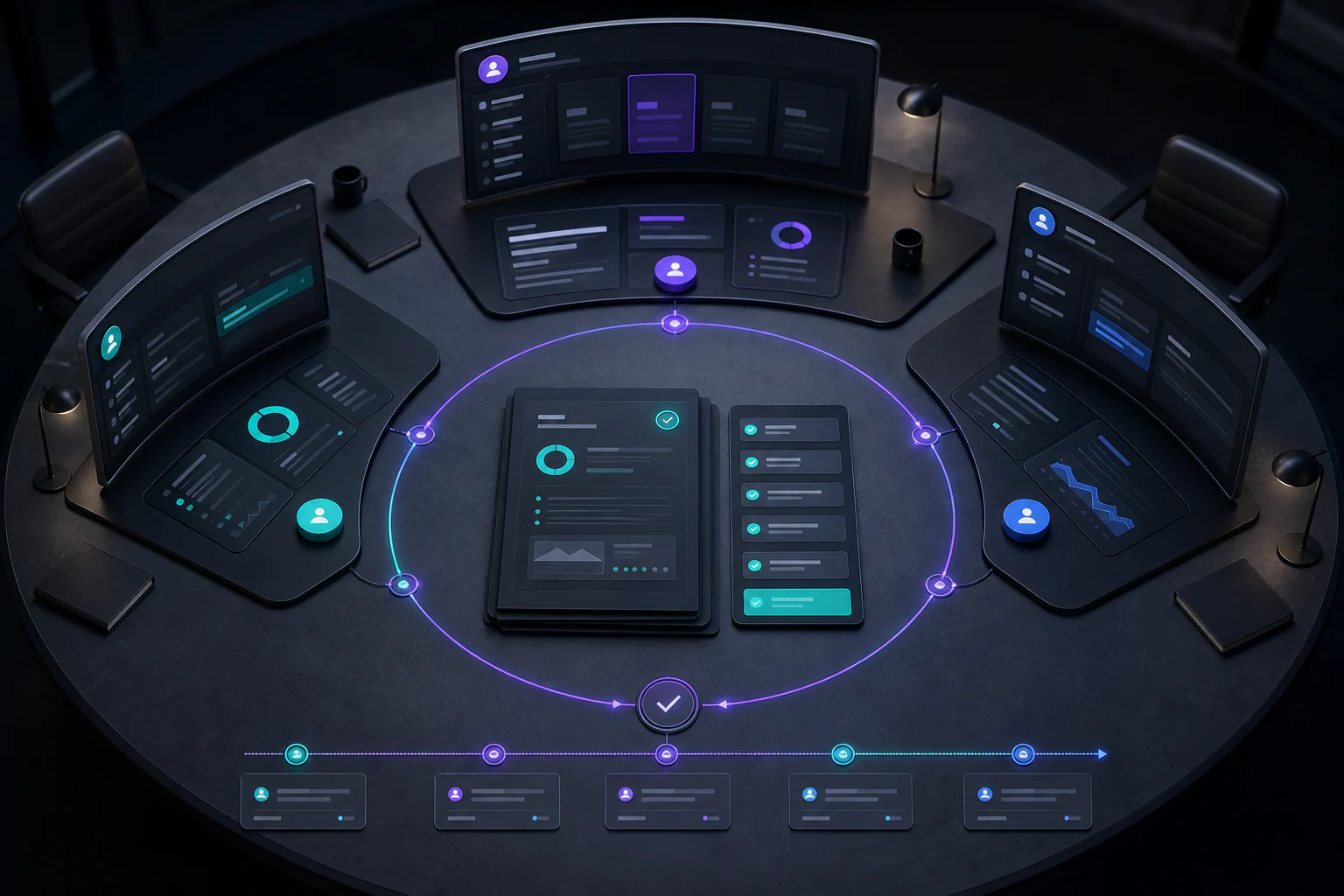
A small prediction-market team can share one workspace without making every person responsible for every record. Begin with an operating map that names who maintains source configurations, who verifies watched markets, who reviews evidence, who checks portfolio and policy context, who handles alert-delivery failures, and who closes the loop in the journal. These responsibilities are team practices; document them in onboarding notes and make sure each person has appropriate workspace access for the actions they perform.
One teammate may cover several responsibilities, especially in a two-person operation. The important point is clarity at the moment work changes hands. A source owner should know where collection history lives, a market reviewer should know the exact contract identity, and a decision reviewer should know where authenticated approve or reject actions are recorded. Naming those boundaries reduces duplicated investigation and prevents an external message or public-wallet change from being mistaken for a workspace decision.
Use stable record identifiers in handoffs. A brief note should include the source or opportunity ID, the reason for attention, the latest verified timestamp, and the unresolved question. The receiving teammate reopens the underlying record rather than relying only on the summary. This habit keeps canonical evidence, market wording, policy reasons, delivery attempts, and paper simulations traceable even when the same person is not available for the entire review.
For RSS and public HTTPS web sources, record a safe label, canonical address, review purpose, and responsible teammate. The owner checks whether the publisher still uses the page, whether stored items carry understandable provenance, and whether collection failures are visible. Canonicalization and content deduplication help keep repeated web material manageable, but the owner still traces attribution and distinguishes an original document from several outlets repeating it. Collection status describes system health, not the reliability of the claim.
Provider-configured Telegram and X readers can contribute source records where those connections are available. Keep provider references and event times visible while protecting credentials. The owner should understand which account or channel was intentionally configured and which market questions the team expects it to inform. A message remains source material until a reviewer verifies it; successful collection does not make it authoritative and does not attach it to every contract sharing a topic.
Test one normal record and one visible failure after a material source change. Confirm that the new item retains publisher or provider identity, observation time, and canonical reference, then inspect how an unavailable state appears to another workspace member. If a page moves, correct the configuration prospectively and retain earlier records. A short source inventory with owner and last-check date helps the team spot abandoned inputs without relying on memory.
A watchlist owner verifies the public market ID, exact question, outcome side, closing condition, and resolution source for every configured market. That person also removes mistaken or resolved entries through the normal workflow while preserving historical records already linked to them. The watchlist defines the workspace’s known coverage. A missing market is not a judgment about importance, so the team should review coverage deliberately instead of interpreting an empty queue as complete research.
An evidence reviewer opens stored source material that carries the supported explicit market identifier and checks whether it addresses the contract’s precise wording. The reviewer records uncertainty, preliminary status, corrections, and shared attribution in a human note. TEMIRIN’s deterministic brief organizes stored fields, while the reviewer determines how a claim matters. Unlinked evidence remains in source context until someone corrects the configuration; it should not be forced into a market card for convenience.
During a handoff, the watchlist owner supplies the contract identity and the evidence reviewer supplies the canonical records considered, not a compressed conclusion without support. Another teammate should be able to reproduce the path from market to evidence and see where judgment begins. If two sources conflict, preserve both and describe the disputed claim precisely. A review can remain unresolved while the team waits for better primary material.
A portfolio reviewer can inspect configured public-wallet snapshots, positions, PnL context, concentration, and observation time. Public records do not establish ownership intent, complete cost basis, or the reason an outside position changed. The reviewer should mark incomplete data and keep wallet observations separate from user-entered paper orders. Combining them would blur an external public record with a workspace simulation and make team reports difficult to reconcile.
A risk reviewer checks the current stake cap, source or category enabled and blocked states, applicable maximum-stake overrides, free-capital percentage, price-move guard, and kill switch. For a paper order, the server evaluates per-order notional, rolling twenty-four-hour notional, per-market exposure, and portfolio concentration. The reviewer explains the returned pass or block reason while keeping the user-entered amount attributable. The person creating the simulation remains responsible for the entered amount.
An operations owner reviews configured email, Telegram, Slack, and outbound webhook attempts in the delivery ledger. That person can inspect failure details and use manual retry when appropriate. Delivery success means a destination accepted the message; it does not prove that a person read it or change the opportunity status. Source collection belongs to its own history, so the operator first identifies whether the missing record began at ingestion or only failed during notification transport.
A decision reviewer records approve or reject inside the authenticated workspace. If the configured price-move guard blocks the action, the reviewer refreshes current market context and examines the record again. Preserve the attempted decision, actor, time, and reason. A later paper order is another user action with its own ledger. Real transactions remain at the venue, and no public-wallet observation or external delivery should be used as a substitute for a workspace decision record.
At the end of a review period, sample fresh, stale, blocked, rejected, untouched, and paper records. Trace each displayed value back to its source, market, policy, decision, delivery, wallet, or paper ledger. Journal notes should preserve the original thesis, uncertainty, disposition, and later lesson without rewriting earlier events. Analytics and export can help compare operating patterns when record types, sample counts, timestamps, and missing fields remain clearly labeled.
Use the routine to improve ownership rather than to score teammates. Repeated collection failures may call for a source change, unclear contracts may call for a stronger watchlist checklist, and recurring delivery errors may call for destination maintenance. Record the action and owner prospectively. TEMIRIN provides shared evidence and audit context, while the team remains responsible for verification, access discipline, capital choices, and every real Polymarket transaction.
The responsibilities matter more than the headcount. One person can own several areas as long as source, market, risk, alert, decision, and journal duties remain clear.
A named teammate should maintain its safe configuration, purpose, provenance quality, and visible collection failures without treating collection success as factual verification.
No. Delivery operations remain separate. Approve or reject is recorded by an authorized user inside the authenticated workspace.
No. Public-wallet data observes outside activity, while paper orders are simulations. Keeping them separate preserves accurate provenance.
Use protected record identifiers, the reason for attention, latest verified timestamps, current state, and the unresolved question so the next reviewer can reopen the evidence.

